

For decades, the cycling world stuck to a few tried-and-true wheel sizes. Mountain bikes originally all had 26-inch wheels – it wasn’t even a choice to consider. Then 29-inch wheels (29ers) arrived and soon dominated, followed by the in-between 27.5-inch (650B) size. These together largely overtook the old 26″ standard, with 29-inch wheels becoming the industry standard.
Today, 32-inch wheels are generating buzz as the next big thing in bike design. What exactly are 32″ bikes, and could this wheel size become the new standard?
Evolution of Bike Wheel Sizes
Bike wheel diameters (including tires) are typically referred to in inches for youth and mountain biking, and in millimeters (or the 700C system) for road and gravel bikes. Here’s a quick overview of the most common sizes and their uses:
- 26-inch: The traditional mountain bike wheel diameter. Bikes with 26″ wheels are quick to accelerate and very agile due to the smaller wheel circumference. They can be made lighter, stiffer, and stronger than larger wheels – which is why 26″ still appears on some dirt jump and freeride bikes. However, a smaller wheel hits bumps at a steeper angle and falls into holes more easily, so 26″ bikes feel rougher and lose speed faster on bumpy terrain.
- 27.5-inch (650B): This “middle” size was introduced to offer a balance between 26 and 29. A 27.5″ wheel rolls more smoothly over obstacles than a 26″, with noticeably better grip and comfort, yet it’s lighter and more nimble than a 29er. Many trail and enduro bikes adopted 27.5″ for its lively handling – it accelerates faster and feels easier to flick around corners compared to 29″.
- 29-inch: 29er bikes have become popular because their larger wheels roll over obstacles more easily and maintain momentum well. The longer contact patch gives improved traction on loose or slippery ground. With advances in frame design and materials, 29″ is now considered suitable for almost all types of terrain – from fast XC courses to technical downhill – offering a confident, stable ride.
- 32-inch: A newer, larger diameter now being tested on mountain bikes. A 32″ wheel is about 9–10% larger in diameter than a 29″, roughly the same kind of jump we previously saw going from 26″ to 29″. Until recently, 32″ wheels were found only on a few custom-built bikes for very tall riders. However, major industry players have started developing 32″ mountain bike equipment, signaling that this size might soon become a viable option for more riders.
- 36-inch: The largest bicycle wheel size in limited use, seen mainly on novelty bikes and custom builds for extremely tall riders. A few boutique brands have made 36-inch wheels, but they are very heavy and uncommon. The 36″ is the outlier size and not on the mainstream radar – though it shows the pursuit of scaling bikes for all rider heights. You will most likely see a 36-inch tire on a unicycle.
| Wheel Size | Description |
|---|---|
| 26-inch | Traditional mountain bike wheel size. Compact diameter with quick handling. Less common on modern bikes but still used in some youth and specialty models. |
| 27.5-inch (650B) | Intermediate wheel size between 26″ and 29″. Offers a balance of rollover capability and maneuverability. Commonly found on trail and enduro bikes. Known for its playfulness. |
| 29-inch (700C) | Widely used standard for modern mountain, gravel, and road bikes. Larger diameter improves rollover and maintains speed efficiently. |
| 32-inch | An emerging wheel size with a larger diameter than 29″. Developed for smoother rollover and stability. Currently limited to prototypes and custom builds. |
| 36-inch | Oversized wheel size with very large diameter. Mainly used in specialty or custom bikes for very tall riders. Rarely seen in mass-market production. |
The Rise of the 32-Inch Wheel
Thirty-two inch wheels are generating a lot of excitement. The concept isn’t completely new, but for the first time, major manufacturers are jumping in. Maxxis, one of the biggest bicycle tire makers, recently invested in developing the first high-performance 32″ mountain bike tire, the Aspen 32×2.4″. They debuted this prototype tire at the Taipei Cycle Show in 2024/2025, which many see as a turning point, indicating that larger brands and race teams are interested.
According to Maxxis, some World Cup cross-country racers requested 32-inch tires, convinced that a bigger wheel could help them go faster in competition. In response, Maxxis developed the Aspen 32″ tire and found in testing that the performance was promising enough to move ahead with production. Other tire brands are following suit – Vee Tire Co. made custom 32″ tires for prototypes, and Schwalbe is rumored to be unveiling a 32-inch tire as well. On the wheel side, companies have shown 32″ rims and even a full-suspension 32″ prototype bike (in collaboration with Maxxis) appeared at the Eurobike show.
All of this indicates that the cycling industry is exploring 32″ wheels, not just as one-off customs but as a potential new category.
Why Bigger Wheels? Benefits of 32″ Bikes
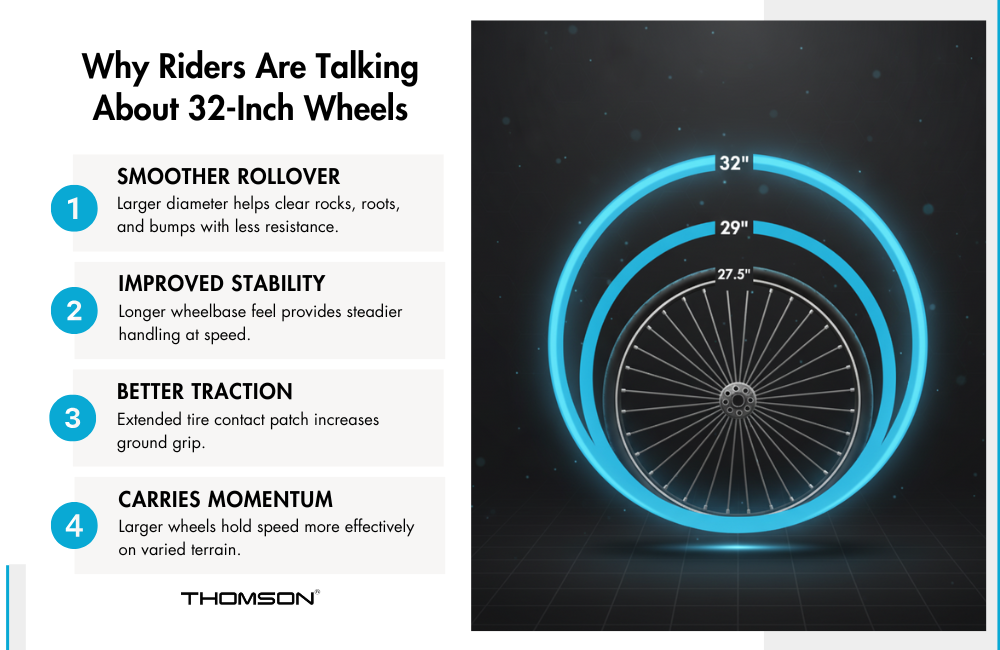
Enhanced Rollover and Smoother Ride
A larger diameter wheel has a shallower attack angle when contacting bumps, roots, and rocks. This means a 32″ wheel can roll over obstacles more easily, without jolting or getting stuck as readily as a smaller wheel. Riders experience a smoother ride and can maintain speed through rough sections instead of slowing down. Essentially, what 29ers already improved over 26″, a 32″ could improve further, tackling big bumps like they’re smaller ones.
Better Traction and Stability
The 32″ wheel’s contact patch (the area of tire touching the ground) is extended slightly in length compared to a 29″ wheel, assuming the same tire width. More rubber on the ground can translate to more traction, especially in loose conditions. In addition, the bike’s overall geometry with big wheels tends to have a longer wheelbase. A longer wheelbase and bigger rotating mass add stability – the bike feels planted and less twitchy, aiding confidence at high speeds or on descents.
Momentum and Efficiency
Once up to speed, large wheels carry momentum very well. A 32″ wheel can sustain speed with slightly less effort, potentially making it faster on open terrain or long rides. Think of it like a larger size flywheel – it’s harder to get going, but it “wants” to keep rolling. Riders who frequently deal with rocks and dips will find the 32″ wheels don’t get bogged down as easily, allowing them to maintain flow.
Proportional Sizing for Tall Riders
A very practical benefit – for cyclists over about 6’4″, even 29″ wheels can look and feel a bit small. Tall riders on high-frame bikes often feel perched on the bike rather than in it. By scaling the wheels (and frame) up, a 32″ bike can fit a tall person with more balanced geometry. Their center of gravity is more between the wheels instead of awkwardly above the rear wheel, which improves both climbing (less front-end lift) and descending control. The bike also simply looks more proportional – no more “circus bike” appearance for the very tall.
Aesthetics and Innovation
While subjective, some riders and designers find that on large bike frames (XL, XXL sizes), the bigger wheels are more aesthetically pleasing. The proportions look “right” when the wheel diameter matches the frame size. This is a minor point, but it complements the functional reasons. More broadly, the introduction of 32″ wheels is sparking innovation and excitement in the bike industry.
Challenges and Limitations of 32″ Wheels
Increased Weight & Slower Acceleration
There’s no way around physics – bigger wheels are heavier. A 32″ wheel has more material in the rim, spokes, and tire, which means extra rotational mass. This makes the bike harder to accelerate from a stop or out of tight corners.
Handling in Tight Corners
A larger wheel can make the bike feel less agile, especially in sharp turns or quick direction changes. Riders who enjoy very tight, technical trails might struggle with the bigger turning radius and increased wheelbase of a 32″ bike. Even 29ers have been critiqued for being a bit unwieldy in slow, twisty sections or when trying to flick the bike around obstacles. A 32″ could accentuate that.
Geometry and Component Challenges
Introducing a new diameter affects the entire bike design. Frame geometry must be adjusted (longer speed chains, taller front ends, seat tube angle, etc.), which can be tricky to keep balanced. Suspension forks and frame clearances have to accommodate the bigger wheels and tires. As of now, there are very few (if any) suspension forks mass-produced for 32″ wheels, so developers are modifying existing forks or working with suspension companies on custom builds.
Momentum vs. Acceleration Trade-off
The flip side of the momentum benefit is that it can be a drawback in certain situations. A heavier, big-wheel bike might be harder to loft off a jump or to scrub speed quickly. Riders who love a bike that they can manual, bunny-hop, and throw around might find a 32″ a bit “dead” feeling or harder to control in the air. Thus, 32″ likely targets endurance, downcountry, and XC racing more than freestyle or downhill riding.
Will 32-Inch Bikes Become Mainstream?
The industry excitement and investment in 32″ development suggest there is momentum. When multiple major companies commit resources, it indicates they see potential. If professional racers start winning events on 32-inch size wheels, that could accelerate adoption. Remember, 29ers were initially met with skepticism too, but once riders realized the performance gains, 26″ wheels rapidly fell out of favor. It’s conceivable that a similar tipping point could occur if 32″ wheels prove to offer a real competitive edge.
On the other hand, there is considerable caution in the air. Many in the bike community doubt that 32″ will ever become as ubiquitous as 29″. One reason is rider size: unlike the 26→29 transition, a 29→32 jump might simply be too large for many riders to comfortably handle. As noted, average and smaller riders probably won’t benefit from such huge wheels. There is an argument it could be worse for shorter riders as well. So 32″ might carve out a more limited domain – perhaps primarily for tall riders and certain racing scenarios.
Thomson Take
It’s very plausible that 32″ wheels will find a strong niche in the market: perhaps in elite cross-country racing, marathon desert events, or among riders over 6’5″ seeking the ultimate comfortable big bike. They might become an option on select bike models (just as some gravel bikes offer both 650B and 700C setups). Over time, if the benefits prove significant and drawbacks are mitigated by improved tech, we could see wider tire adoption. However, 29″ wheels are not going anywhere; they will continue to be the go-to size for the majority of riders and bikes, given their well-rounded performance.
In the end, the rise of the 32″ wheel is an exciting development for cycling enthusiasts. It shows that bike design is still evolving and that manufacturers like us are always searching for that next improvement in performance. At Thomson Bikes, we’re closely following this trend. As a company known for precision components and rider-focused design, we appreciate innovations that can make riding even better.
Customize Your Ride
At Thomson, we design precision CNC components, seatposts, stems, handlebars, and frames that riders trust for performance and longevity. Every rider has thei own preferences, which is why we give you the freedom to customize your build the way you want.